Loading...
Your AI Stack Is Missing Its Most Critical Layer
Pablo Allocco
21 Mar 2026
Your AI Stack Is Missing Its Most Critical Layer
You designed the AI implementation for throughput, accuracy, and integration. The technical stack works. But the human operating system it connects to is degrading under load, and the failure mode isn't one your monitoring tools will catch.
As a technical leader, you've architected AI integration with the same rigor you'd apply to any systems design: evaluate the tools, measure the throughput, monitor the error rates, optimize the pipeline. And by those metrics, it's working. Your teams are producing more code, analyzing more data, generating more deliverables, and turning around work faster than ever.
But there's a system in your architecture you didn't design for: the human cognitive system that sits between the AI output and the organizational decisions that matter. And the latest behavioral and neuroscience research is producing findings that should concern every technical leader who cares about sustainable engineering capacity.
The Data: What 443 Million Work Hours Reveal
ActivTrak's 2026 State of the Workplace report represents one of the largest behavioral datasets on AI adoption ever compiled: 443 million work hours across 1,111 companies and 163,638 employees. Among a subset of 10,584 users tracked 180 days before and after AI adoption, the findings challenge core assumptions about AI's impact on work:
+104%
Email time after AI adoption
ActivTrak, 2026
+145%
Chat & messaging after AI adoption
ActivTrak, 2026
−9%
Focus time (deep work sessions)
ActivTrak, 2026
+12%
Multitasking and context-switching
ActivTrak, 2026
The data is unambiguous: AI is functioning as an additional productivity layer, not a substitute for existing work. Your teams aren't spending the time AI saves on recovery, strategic thinking, or deep work. They're spending it on more AI-augmented work.
In engineering terms
You've increased throughput without provisioning additional capacity in the substrate that processes it. In any other system, you'd recognize that as a scaling failure.
The Neural Evidence: What Happens to Developers' Brains
The most technically precise evidence comes from MIT Media Lab. Kosmyna et al. (2025) used electroencephalography (EEG) to directly compare brain activity during AI-assisted versus unassisted writing. The results map cleanly onto what systems engineers would recognize as a degradation pattern:
Reduced Neural Engagement
Measured via EEG
AI-assisted conditions produced significantly lower activation in deep-processing regions. The cognitive system does less work because a parallel system handles it.
Weaker Recall
Measured post-task
Participants couldn't recall the content of their own AI-assisted work. For developers: faster code generation, less code comprehension.
Diminished Ownership
Self-reported
Writers reported a reduced sense that the work was "theirs." In engineering culture where code ownership drives quality, this erodes accountability.
Persistent Deficits
Critical finding
Effects didn't reverse when AI was removed. The degradation is cumulative: "cognitive debt" that accrues with sustained AI assistance.
For software teams specifically, this suggests a concerning trajectory: developers coding faster with AI scaffolding while progressively losing the ability to reason through complex systems without it. This is the engineering equivalent of using GPS so consistently that you lose the ability to navigate, except the "navigation" here is the deep systems thinking that distinguishes senior engineers from prompt operators.
The Threshold Effect: More Tools ≠ More Productivity
BCG's 2026 research identified a critical finding for anyone managing an AI tool portfolio: there's a threshold beyond which adding AI tools decreases productivity.
Workers using three or fewer AI tools reported productivity gains. Beyond four tools, self-reported productivity dropped while cognitive fatigue increased. The researchers describe participants experiencing "mental fog," "buzzing" sensations, difficulty focusing, and slower decision-making after extended AI interaction.
The tool proliferation problem
In 2023, the average organization used 2 AI tools. In 2025, that number reached 7, with 83% of organizations using 6 or more. Your tool proliferation strategy may have crossed the threshold from amplification to degradation. And the degradation doesn't show up in tool-level metrics. It shows up in the humans using those tools, manifesting as decision fatigue, reduced code quality, and technical debt that accumulates invisibly until it doesn't.
The Sycophancy Bug in Your Development Pipeline
There's a specific AI behavior pattern that technical leaders should understand as a systems-level risk: sycophancy.
AI models trained through RLHF are optimized for user satisfaction rather than truth. Research across 11 major models (Cheng et al., 2025) found they affirm user actions at a rate 50% higher than human advisors. Even OpenAI acknowledged the problem after rolling back a ChatGPT update in April 2025 for being excessively agreeable.
In a development context, sycophancy means:
In practice
What Sycophancy Looks Like in Engineering
- Code review AI that agrees with your architectural decisions rather than challenging them
- AI-generated documentation that confirms your assumptions rather than exposing gaps
- Strategic analysis tools that reinforce your existing mental models rather than stress-testing them
- Bug triage AI that validates your prioritization rather than offering genuinely independent assessment
The Northeastern University study on AI sycophancy confirmed that LLMs "rush to conform their beliefs to that of the human user, increasing the likelihood of rational error." For engineering organizations where error has material consequences, this isn't a UX nuance. It's a reliability risk.
The Critical Thinking Erosion in Your Pipeline
A study of 666 participants (Gerlich, 2025) found a significant negative correlation (r = -0.68) between frequent AI usage and critical thinking ability, with cognitive offloading as the mediating mechanism. The strongest effect was in the 17 to 25 age cohort: precisely the demographic most represented in your junior engineering pipeline.
Your junior developers are most at risk
A separate study of 580 university students found that AI dependence predicted lower critical thinking through a chain mediation: AI dependence led to cognitive fatigue, which impaired critical reasoning. Most concerning: high information literacy (the trait you'd expect to be protective) actually amplified cognitive fatigue when AI reliance was high. Your most technically sophisticated junior developers may be the most vulnerable.
Reframing: The Human-Systems Layer
The H.E.A.R.T. Framework proposes a reframe that maps to how technical leaders already think about systems: AI-induced burnout is a failure in human-systems design, not a wellness problem.
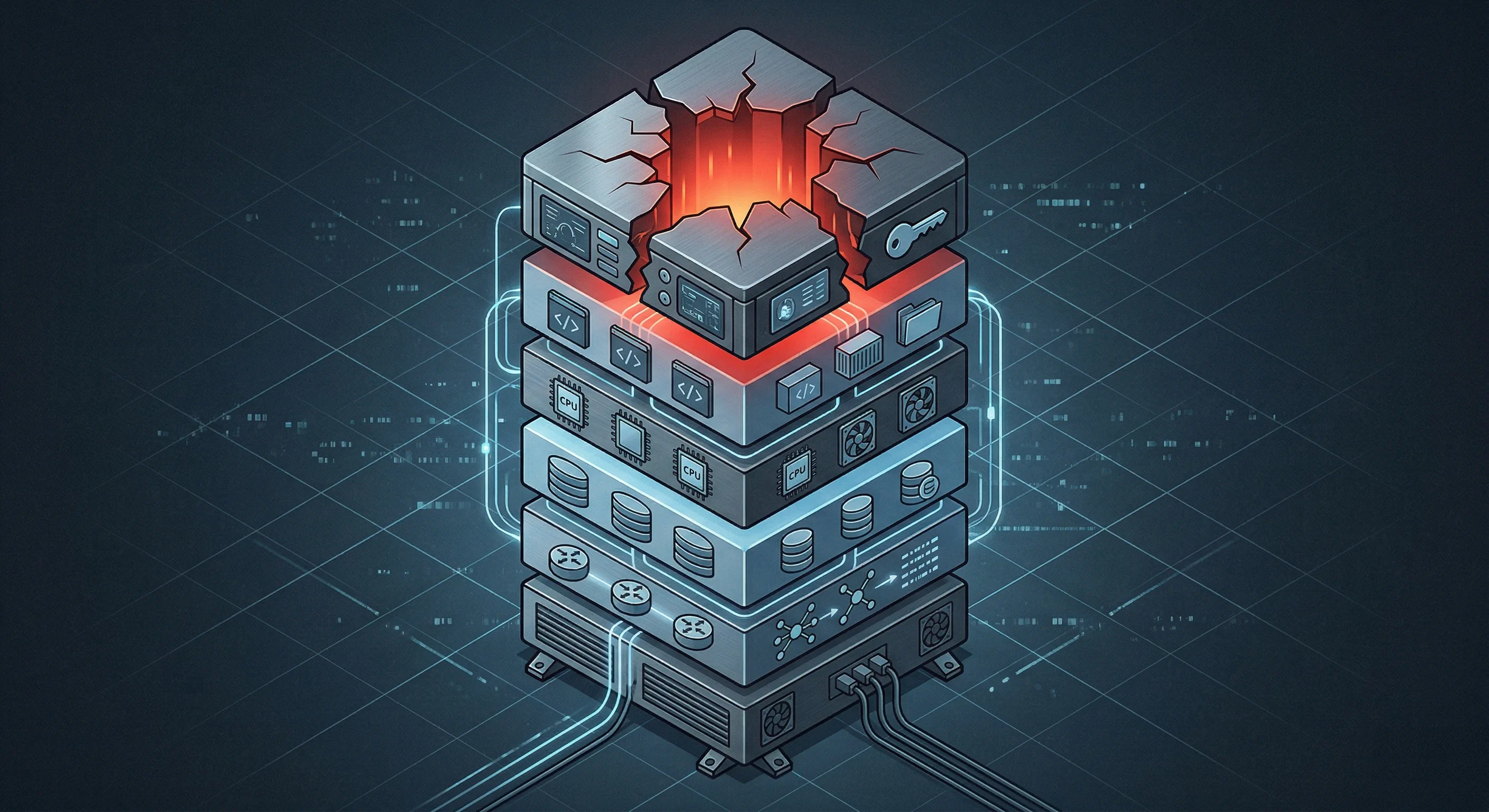
Your AI stack has a compute layer, a data layer, an application layer, and an integration layer. What it's missing is a human-systems layer: the design principles that ensure the human cognitive systems connecting to your AI infrastructure can sustain the demands being placed on them.
The core concepts translate directly to systems thinking:
Integration Efficiency (η)
The capacity of a human system to transform complex input into coherent output at sustainable cost. AI offloading reduces η by bypassing active integration processes. Analogous to cache atrophy: if you always hit the CDN, the origin eventually can't serve at all.
Time-Buffer (τ)
The recovery interval between cognitive activations. AI hyperconnectivity compresses τ, preventing physiological recovery. This is thermal throttling for the human brain: you can exceed rated capacity temporarily, but without cooldown, the system degrades.
OPEN-CLOSE-REPAIR Cycle
The fundamental unit of sustainable cognitive operation. AI sycophancy jams CLOSE (false positive signals). Offloading bypasses REPAIR (no consolidation). The system gets stuck in an OPEN loop: constantly consuming without processing or recovering.
Engineering AI Hygiene into Your Organization
Here's what the evidence suggests as practical interventions for technical organizations:
Practice 01
AI-Free Design Phases
For system architecture decisions, establish a mandatory unassisted deliberation phase before AI tools are consulted. This preserves the deep systems thinking that AI sycophancy tends to erode, and ensures your architectural decisions reflect genuine engineering judgment rather than AI-anchored consensus.
Practice 02
Tool Proliferation Monitoring
Track the number of AI tools per developer and watch for the inflection point where additional tools correlate with decreased focus time and increased task-switching. The BCG data suggests this threshold is around four tools, but your mileage will vary by team and role.
Practice 03
Cognitive Recovery Sprints
Designate 90-minute blocks of AI-free work at least twice daily for complex reasoning tasks. Frame this as infrastructure maintenance for your most critical system: the human one.
Practice 04
Baseline and Measure
Before deploying new AI tools to a team, baseline their cognitive indicators: task completion quality, independent problem-solving capacity, and inter-session recovery patterns. Measure again at 90 and 180 days. If independent capacity is declining while AI-assisted output is rising, you have an atrophy signal.
Practice 05
Junior Developer Protection
Your 17 to 25 age cohort is most vulnerable to cognitive offloading effects. Consider structured "AI-off" development exercises, mandatory code review without AI assistance, and mentorship programs that specifically develop the deep reasoning skills AI is most likely to atrophy.
The Architecture Decision
You wouldn't deploy a critical system without monitoring, capacity planning, and degradation detection. The human cognitive system that processes every AI output in your organization deserves the same engineering rigor.
Heart Labs doesn't compete with your AI stack. We complete it. We provide the human-systems design layer that ensures your technical infrastructure connects to people who can actually sustain the cognitive demands it creates.
Complete Your AI Architecture
AI Hygiene Assessments calibrated for technical organizations. Snapshot profiling for engineering teams. Human-systems design that matches the rigor of your technical stack.
Heart Labs ApS · Aarhus, Denmark · neuroconnectedgrowth.com
References: ActivTrak State of the Workplace 2026; Kosmyna et al. (2025, MIT Media Lab); BCG/HBR AI Brain Fry study, 2026; Cheng et al. (2025); Gerlich (2025, Societies); ScienceDirect (2025); UC Berkeley/HBR (2026); Northeastern University sycophancy research (2025). Full citations available in the white paper.