Loading...
What If POTS, ME/CFS and Long COVID Are Neuroimmune Disorders?
Tamara Logica
06 Oct 2026
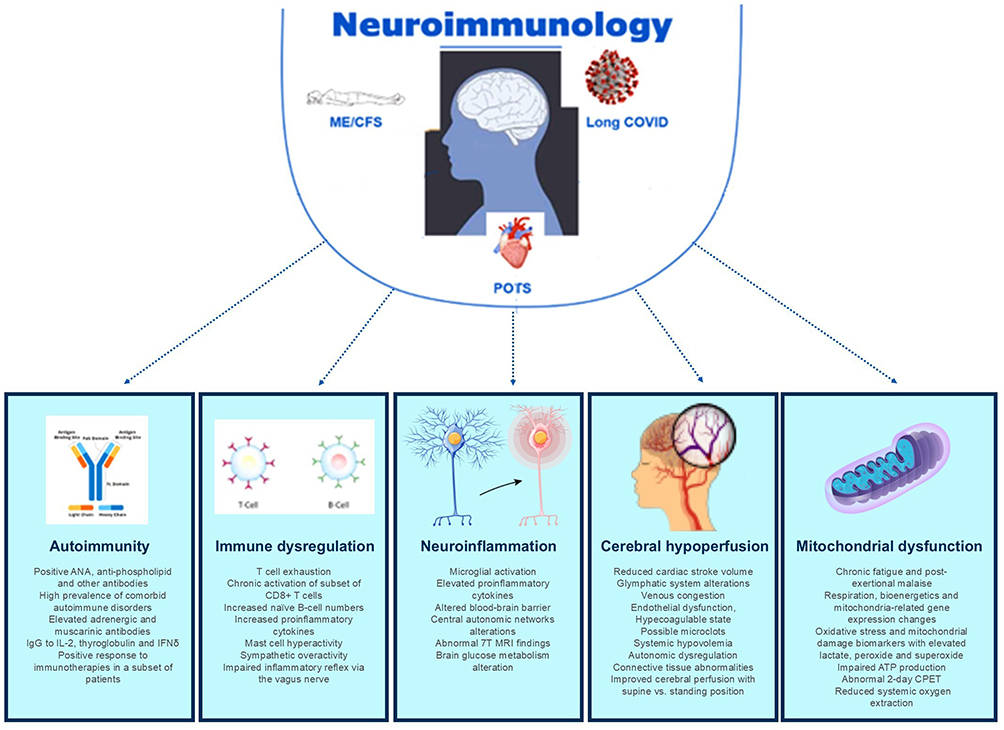
What if conditions medicine once dismissed as 'all in the head' are, in fact, about the conversation between the brain and the immune system?
For decades, people living with postural orthostatic tachycardia syndrome (POTS), myalgic encephalomyelitis/chronic fatigue syndrome (ME/CFS) and, more recently, Long COVID were told their tests were 'normal' and that their symptoms must be psychological. A 2026 narrative review by neurologist Svetlana Blitshteyn, immunologist Taylor Doherty and neuroimmunologist Lawrence Steinman argues for a different framing: these three conditions overlap biologically, and they belong under the umbrella of neuroimmunology, alongside multiple sclerosis (Blitshteyn et al., 2026).
This article translates that review for a general audience. We separate what the research supports from what is still a bold hypothesis, so you can see both the evidence and the open questions.
POTS
A heart rate that climbs by more than 30 beats per minute within 10 minutes of standing (more than 40 for ages 12 to 19), without a drop in blood pressure, with symptoms lasting at least 3 months (Freeman et al., 2011).
ME/CFS
Disabling, long-lasting fatigue with orthostatic intolerance as one of its recognized features, and measurable immune abnormalities in deep-phenotyping studies (Walitt et al., 2024).
Long COVID
An infection-associated chronic condition present for at least 3 months after SARS-CoV-2 infection that can affect one or more organ systems (National Academies of Sciences, Engineering, and Medicine [NASEM], 2024).
One overlap, three names
POTS and ME/CFS are the two most common phenotypes of Long COVID, and many patients meet criteria for more than one condition. In a large community survey, at least 20% of people with POTS also satisfied the diagnostic criteria for ME/CFS (Shaw et al., 2019). The shared mechanisms below are what lead the authors to argue these are neighbors, not strangers.
Six threads in the evidence
The review pulls together six mechanisms that keep appearing across all three conditions. None works alone, and researchers are still mapping how they interact.
1. Autonomic dysfunction
The autonomic nervous system steers heart rate, blood pressure, digestion and temperature. Autonomic dysfunction is reported in nearly 70% of people with Long COVID (Blitshteyn et al., 2026; Larsen et al., 2022).
2. Immune dysregulation
ME/CFS and Long COVID both show altered immune profiles, including signs of exhausted T cells and elevated inflammatory signals (Peluso & Deeks, 2024; Walitt et al., 2024). For POTS, immune profiling is still very limited.
3. Autoimmunity
Antibodies that target receptors involved in autonomic signaling have been found in POTS, and similar ones in Long COVID and ME/CFS (Li et al., 2014; Sotzny et al., 2018).
4. Mitochondrial dysfunction
Mitochondria are the cell's power plants. Their role in fatigue is considered established in ME/CFS, while in POTS it is still being worked out (Blitshteyn et al., 2026).
5. Cerebral hypoperfusion
Reduced blood flow to the brain and brainstem is emerging as a major mechanism in POTS and ME/CFS, and probably in Long COVID. Why it happens is still unclear (Blitshteyn et al., 2026).
6. Neuroinflammation
Activated microglia, the brain's resident immune cells, were detected by specialized PET imaging in people with Long COVID and cognitive symptoms (Braga et al., 2023).
The numbers behind the argument
A few figures from the review help show how strongly the immune system appears in these conditions. They come from different studies and populations, so they are not meant to be compared with each other.
Sources: Blitshteyn et al. (2026); Larsen et al. (2022); Konstantinov et al. (1996); Shaw et al. (2019).
What if...
This is where the review looks forward. The following ideas are supported by early evidence but are not settled science.
What if the brainstem is a shared control room?
Using 7 Tesla MRI, researchers found structural abnormalities in the dorsolateral medulla of people with Long COVID, and these correlated with symptoms (Rua et al., 2024). This region houses vagal nuclei and vestibular pathways. Blitshteyn (2025) proposes it could also be where POTS originates, whether or not a COVID infection triggered it. This is a hypothesis awaiting confirmation.
What if the nervous system can read threat and call the immune system into action?
The vagus nerve is the core of the inflammatory reflex, a circuit linking the nervous system to immune responses (Pavlov & Tracey, 2012). Insular cortex neurons in mice can store and retrieve specific immune responses (Koren et al., 2021). In humans, simply anticipating infection in virtual reality triggered an immune response, even without physical contact (Trabanelli et al., 2025). What if, in some chronic conditions, this brain-immune dialogue gets stuck in the wrong gear?
What if some patients have an immune phenotype that responds to immunotherapy?
The authors call for studies that test for T-cell exhaustion and other immune signatures in POTS, so researchers can identify subgroups who might benefit from immunotherapies. For now, this remains a research priority rather than a proven treatment (Blitshteyn et al., 2026).
What if energy metabolism is part of the answer?
In a small open-label pilot of 20 people with POTS, six months of time-restricted eating was linked with improvements in upright heart rate, energy and mitochondrial function (Dzotsi et al., 2025). With no control group, this is a signal worth testing, not a recommendation.
Evidence at a glance
| Statement | Status | Key source |
|---|---|---|
| POTS and ME/CFS are major phenotypes of Long COVID | Supported | Blitshteyn et al. (2026) |
| Autonomic dysfunction is very common in Long COVID | Supported | Larsen et al. (2022) |
| Autoantibodies are found in POTS, ME/CFS and Long COVID | Supported (causal role still debated) | Li et al. (2014); Sotzny et al. (2018) |
| Microglial activation accompanies cognitive symptoms in Long COVID | Supported (small studies) | Braga et al. (2023) |
| Brainstem inflammation is a shared origin of POTS and Long COVID | Hypothesis | Blitshteyn (2025); Rua et al. (2024) |
| Mitochondrial dysfunction drives fatigue in POTS | Hypothesis | Dzotsi et al. (2025); more research needed |
| Immunotherapies can help defined patient subgroups | Hypothesis | To be tested |
The stigma story, and why labels matter
The authors point to a historical parallel. Multiple sclerosis was once labeled hysterical paralysis, until its biological basis was uncovered and it became a recognized neuroimmune disease. They argue that POTS, ME/CFS and Long COVID have traveled a similar road, with patients often misdiagnosed with anxiety, somatization or functional disorders because routine tests came back normal (Blitshteyn et al., 2024; Davenport et al., 2024). Their proposal is that the first step is to stop assuming a psychological cause, and to build neuroimmunology training, consensus guidance and care pathways for these patients.
It is worth noting what this does not say. Recognizing a biological basis does not mean psychological support has no place. It means that suffering should not be dismissed as purely psychological while the biology is still being mapped.
What would change if this view takes hold?
- Diagnosis: a 10-minute standing test instead of a seated vital-sign check, with tilt-table and autonomic testing where available.
- Research: advanced imaging, immune profiling and autonomic testing becoming routine tools rather than rare ones.
- Treatment: new and repurposed immune-modulating or anti-inflammatory therapies tested in well-defined subgroups.
- Training: neurologists and neuroimmunologists equipped to recognize and treat these conditions.
The question is no longer whether the brain and the immune system talk to each other. It is what happens to people when that conversation breaks down, and whether medicine is ready to listen.
This article is an educational summary of a narrative review, not medical advice. If you have symptoms such as a racing heart on standing, lightheadedness or persistent fatigue, a clinician familiar with autonomic disorders can help you explore the options.
References
Blitshteyn, S. (2025). Neuroinflammation at the dorsolateral inferior medulla: A possible central nervous system localization for POTS and Long COVID. Biomedicines, 13(1), 166. https://doi.org/10.3390/biomedicines13010166
Blitshteyn, S., Doherty, T. A., & Steinman, L. (2026). Postural orthostatic tachycardia syndrome, myalgic encephalomyelitis/chronic fatigue syndrome and Long COVID as neuroimmune disorders. ImmunoTargets and Therapy, 15, 581262. https://doi.org/10.2147/ITT.S581262
Blitshteyn, S., Treisman, G. J., Ruhoy, I. S., et al. (2024). Postural orthostatic tachycardia syndrome and other common autonomic disorders are not functional neurologic disorders. Frontiers in Neurology, 15, 1490744. https://doi.org/10.3389/fneur.2024.1490744
Braga, J., Lepra, M., Kish, S. J., et al. (2023). Neuroinflammation after COVID-19 with persistent depressive and cognitive symptoms. JAMA Psychiatry, 80(8), 787. https://doi.org/10.1001/jamapsychiatry.2023.1321
Davenport, T. E., Blitshteyn, S., Clague-Baker, N., et al. (2024). Long COVID is not a functional neurologic disorder. Journal of Personalized Medicine, 14(8), 799. https://doi.org/10.3390/jpm14080799
Dzotsi, M., Strohm, A., Varshney, S., et al. (2025). Time-restricted eating improves quality of life, heart rate, and mitochondrial function in patients with postural orthostatic tachycardia syndrome: An open-label pilot study. Scientific Reports, 15(1), 34345. https://doi.org/10.1038/s41598-025-16836-2
Freeman, R., Wieling, W., Axelrod, F. B., et al. (2011). Consensus statement on the definition of orthostatic hypotension, neurally mediated syncope and the postural tachycardia syndrome. Clinical Autonomic Research, 21(2), 69–72. https://doi.org/10.1007/s10286-011-0119-5
Konstantinov, K., von Mikecz, A., Buchwald, D., Jones, J., Gerace, L., & Tan, E. M. (1996). Autoantibodies to nuclear envelope antigens in chronic fatigue syndrome. Journal of Clinical Investigation, 98, 1888–1896. https://doi.org/10.1172/JCI118990
Koren, T., Yifa, R., Amer, M., et al. (2021). Insular cortex neurons encode and retrieve specific immune responses. Cell, 184(24), 5902–5915. https://doi.org/10.1016/j.cell.2021.10.013
Larsen, N. W., Stiles, L. E., Shaik, R., et al. (2022). Characterization of autonomic symptom burden in long COVID: A global survey of 2,314 adults. Frontiers in Neurology, 13, 1012668. https://doi.org/10.3389/fneur.2022.1012668
Li, H., Yu, X., Liles, C., et al. (2014). Autoimmune basis for postural tachycardia. Journal of the American Heart Association, 3(1), e000755. https://doi.org/10.1161/JAHA.113.000755
National Academies of Sciences, Engineering, and Medicine. (2024). A long COVID definition: A chronic, systemic disease state with profound consequences. The National Academies Press. https://doi.org/10.17226/27768
Pavlov, V. A., & Tracey, K. J. (2012). The vagus nerve and the inflammatory reflex: Linking immunity and metabolism. Nature Reviews Endocrinology, 8(12), 743–754. https://doi.org/10.1038/nrendo.2012.189
Peluso, M. J., & Deeks, S. G. (2024). Mechanisms of long COVID and the path toward therapeutics. Cell, 187(20), 5500–5529. https://doi.org/10.1016/j.cell.2024.07.054
Rua, C., Raman, B., Rodgers, C. T., et al. (2024). Quantitative susceptibility mapping at 7 T in COVID-19: Brainstem effects and outcome associations. Brain, 147(12), 4121–4130. https://doi.org/10.1093/brain/awae215
Shaw, B. H., Stiles, L. E., Bourne, K., et al. (2019). The face of postural tachycardia syndrome: Insights from a large cross-sectional online community-based survey. Journal of Internal Medicine, 286(4), 438–448. https://doi.org/10.1111/joim.12895
Sotzny, F., Blanco, J., Capelli, E., et al. (2018). Myalgic encephalomyelitis/chronic fatigue syndrome: Evidence for an autoimmune disease. Autoimmunity Reviews, 17(6), 601–609. https://doi.org/10.1016/j.autrev.2018.01.009
Trabanelli, S., Akselrod, M., Fellrath, J., et al. (2025). Neural anticipation of virtual infection triggers an immune response. Nature Neuroscience, 28(9), 1968–1977. https://doi.org/10.1038/s41593-025-02008-y
Walitt, B., Singh, K., LaMunion, S. R., et al. (2024). Deep phenotyping of post-infectious myalgic encephalomyelitis/chronic fatigue syndrome. Nature Communications, 15, 907. https://doi.org/10.1038/s41467-024-45107-3
— HeartLabs Team