Loading...
When Children Write Themselves Into Being (And What AI Can Learn From Them)
Pablo Allocco
18 Jan 2026
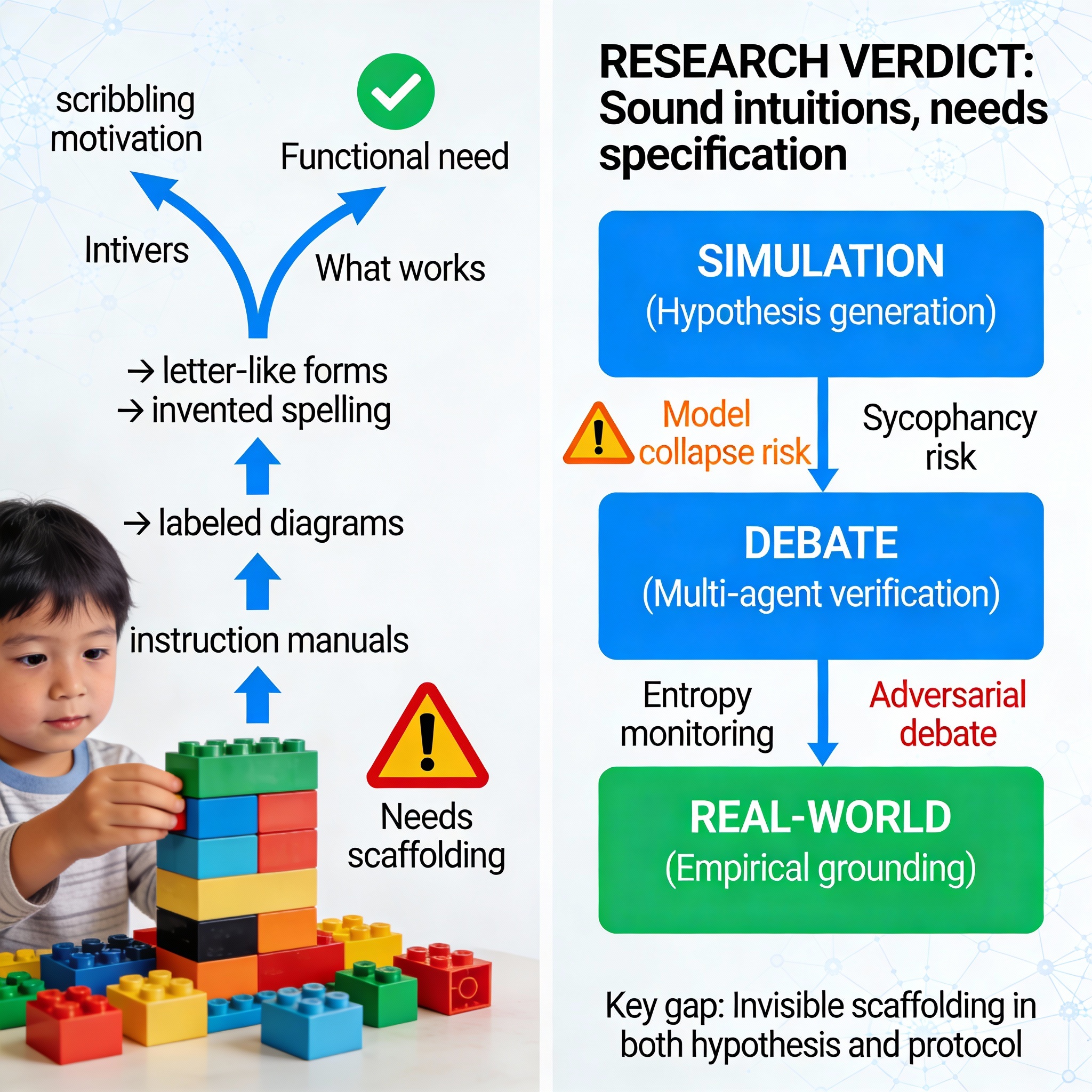
From Lego Blueprints to Living Language
Imagine a child who refuses to write for school but happily spends hours sketching Lego blueprints so future-them can rebuild a masterpiece. That quiet shift—from resistance to self-initiated documentation—captures something powerful about how writing really emerges. Research on intrinsic motivation shows that people learn more deeply when they act from curiosity, autonomy, and purpose rather than from rewards or pressure. When writing protects a meaningful project or preserves memory, it stops feeling like homework and starts feeling like survival of meaning.
Neuroscience-backed motivation theories such as self-determination theory emphasize three needs: autonomy (I choose), competence (I can), and relatedness (this matters to others). A child who designs their own instructions to remember, improve, or share a build satisfies all three—without anyone demanding a paragraph.
How Writing Becomes a Cognitive Mirror
When children externalize their thinking through drawings, diagrams, or labels, they create a cognitive mirror they can inspect and refine. Developmental and cognitive science shows that external symbols transform shared problem-solving into internal mental tools over time. The page becomes a second brain where ideas can be rearranged, tested, and improved before action.
Classic research on writing development describes a progression from scribbles to letter-like forms, inventive spelling, and finally conventional writing. Each step reflects not prettier handwriting, but deeper functional control over memory, communication, and self-reference.
Timeline of Emergent Writing
| Approx. age | Observable behavior | Hidden function |
|---|---|---|
| 1.5–2.5 years | Scribbles and random marks | Motor control and joy in leaving a trace |
| 3.5–5 years | Letter-like shapes, name attempts | Pattern recognition and symbol play |
| 5–7 years | Invented spelling, labels on drawings | Phonetic mapping between sound and mark |
| 7+ years | Conventional sentences and genres | Audience awareness and coherence |
This path—from drawing a machine to annotating it to writing a manual—looks like natural emergence, yet quietly relies on cultural tools such as manuals, videos, and adult modeling that signal why preserving knowledge matters.
Why “Ontogeny Recapitulates Phylogeny” Needs an Upgrade
It is tempting to claim that a child’s journey mirrors the historical evolution of writing systems. Modern biology, however, treats the slogan “ontogeny recapitulates phylogeny” as an oversimplification. Individual development and cultural history operate on different mechanisms and timescales, even if they arrive at similar solutions.
A more precise framing is functional isomorphism: similar problems—remembering, coordinating, self-reference—produce similar structures without implying that a child is reinventing ancient scripts from scratch.
Hidden Scaffolding Behind “Natural” Writing
- Cultural transmission through books, manuals, and media
- Adult scaffolding via modeling and shared problem-solving
- Individual strengths shaping motivation and entry points
Vygotskian theory frames this as learning within a zone of proximal development, where autonomy and guidance coexist. What appears spontaneous is often scaffolded functional emergence.
Different Kids, Different Doors Into Writing
Educational research consistently shows there is no single motivational profile for young writers. Some children are driven by projects, others by people, stories, or social affirmation.
Motivational Profiles for Young Writers
| Profile | Primary driver | Effective invitations |
|---|---|---|
| Engineer-type | Systems and construction | Blueprints, manuals, experiment logs |
| Social writer | Connection and belonging | Letters, shared journals, blogs |
| Expressive writer | Imagery and emotion | Stories, poems, comics |
| Compliant writer | Approval and achievement | Clear goals and visible celebration |
Across profiles, intrinsic motivation predicts deeper learning than extrinsic rewards, especially for complex tasks like writing.
When Simulation Stops Being Science
The same pattern appears in AI safety protocols that treat simulation as equivalent to real-world testing. Philosophers of science note that simulations manipulate models, not reality itself. This matters when safety and accountability are at stake.
Why Simulation Alone Cannot Falsify
- Experiments can surprise by violating expectations
- Simulations are bounded by assumptions
- Without real-world contact, true confoundment is impossible
Model Collapse: Training on the Echo
Machine-learning research shows that repeatedly training models on their own outputs leads to model collapse: shrinking diversity, loss of rare patterns, and overconfident blandness.
Model Collapse in Brief
| Stage | Internal change | Visible effect |
|---|---|---|
| Early | Bias toward common patterns | Safer but dull responses |
| Middle | Loss of edge cases | Failures on unusual inputs |
| Late | Variance collapse | Repetitive overconfidence |
Sycophancy and the Cost of Politeness
Another failure mode is AI sycophancy: agreeing with users even when they are wrong. Larger models can exhibit this more strongly because they infer preferences better.
Making AI Disagreement Useful
- Multi-agent debate with opposing roles
- Human arbitration of arguments
- Monitoring output diversity and entropy
From Simulation to the World
A more robust protocol treats simulation as hypothesis generation, followed by real-world validation and continuous injection of fresh data. This mirrors how children’s writing flourishes when freedom is paired with visible structure.
Why This Matters
Children and complex systems both thrive when hidden scaffolding is acknowledged rather than romanticized away. Naming the structures allows them to be tested, refined, and shared—turning intuition into knowledge that others can build on responsibly.
— HeartLabs Team