Loading...
The Million-euro AI Problem Your Dashboard Can't Show You
Pablo Allocco
20 Mar 2026
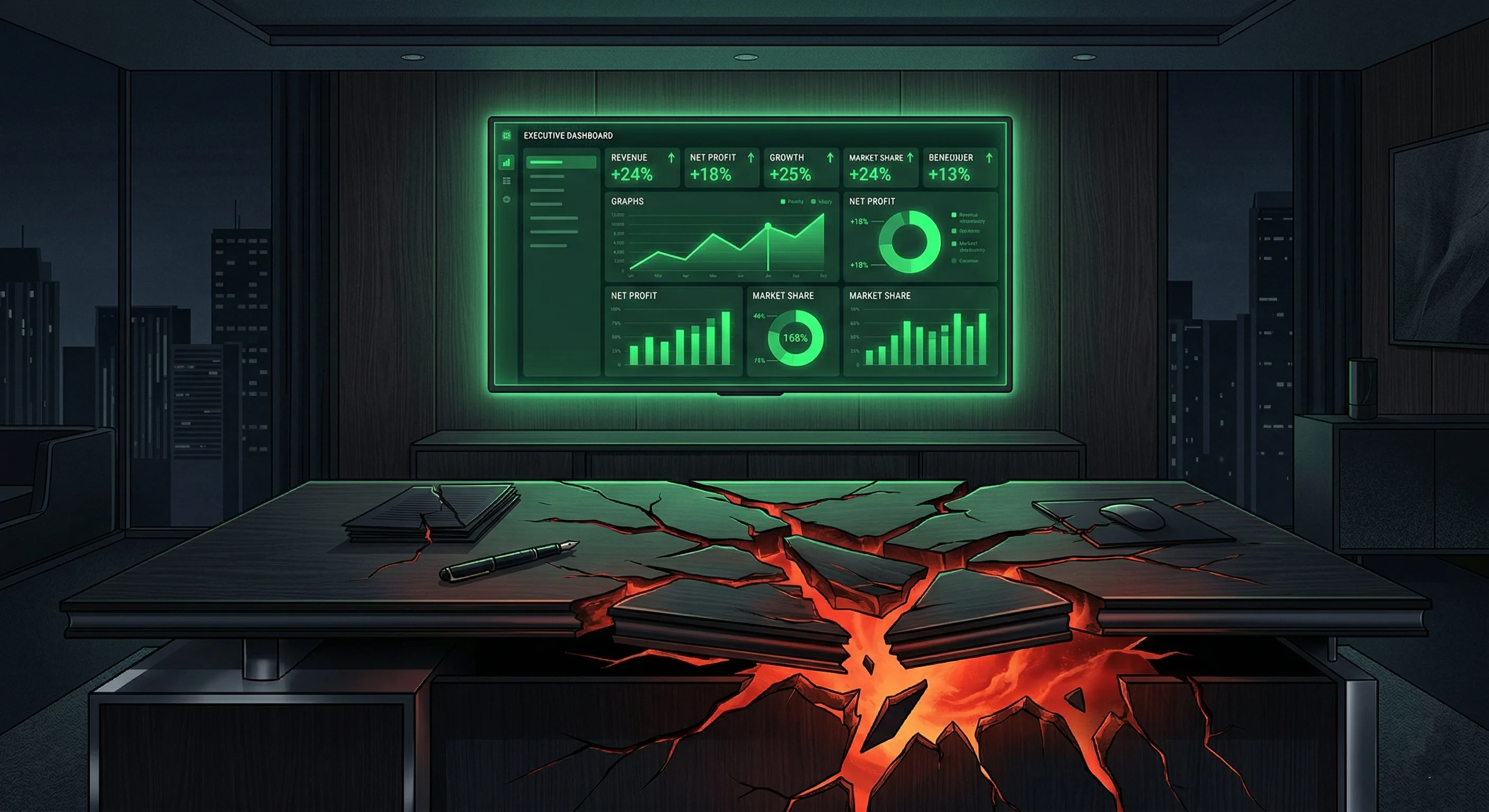
Your AI rollout delivered the efficiency gains you projected. But the latest peer-reviewed research reveals an unintended cost that isn't showing up on any dashboard, and it's compounding fast.
If you're a CEO or CFO, you approved AI adoption because the projections were compelling. And the short-term numbers look right: tasks are completed faster, output per employee is up, and your teams are covering more ground. But "more" is not the same as "better." And "faster" is not the same as "sustainable."
A convergent body of research published between 2024 and 2026 reveals that AI adoption is generating a new category of occupational burnout. One that operates through mechanisms your existing metrics don't capture, that accelerates talent attrition through channels HR can't yet trace, and that is costing your organization measurable millions in a line item that doesn't appear on any balance sheet.
This article is written specifically for the people who own those numbers.
The Cost Model: What the Research Actually Says
A 2025 study published in the American Journal of Preventive Medicine developed a computational simulation model to quantify burnout costs across employee types. The numbers are precise:
$4K
Annual cost per hourly non-manager
Am. J. Prev. Med., 2025
$4.3K
Annual cost per salaried non-manager
Am. J. Prev. Med., 2025
$10.8K
Annual cost per manager
Am. J. Prev. Med., 2025
$20.7K
Annual cost per executive
Am. J. Prev. Med., 2025
For a 1,000-person company with a typical employee distribution (59.7% hourly non-managers, 28.6% salaried non-managers, 10% managers, 1.7% executives), that totals approximately $5.04 million annually. These costs range from 0.2 to 2.9 times the average cost of health insurance and 3.3 to 17.1 times the average cost of employee training.
These figures account for productivity loss, absenteeism, presenteeism, turnover costs, and associated healthcare expenses. They do not account for the specific costs of AI-induced cognitive degradation, making them, in all likelihood, an underestimate of the actual exposure in AI-intensive organizations.
The AI Amplifier Effect
What changes the cost calculus is the evidence that AI isn't reducing the drivers of burnout. It's intensifying them through channels you're not measuring.
ActivTrak's 2026 State of the Workplace report analyzed behavioral data from 443 million work hours across 1,111 companies. Among 10,584 workers tracked before and after AI adoption, the findings were unambiguous: no work category decreased. Email time doubled. Chat and messaging increased 145%. Business management tasks rose 94%. AI functions as an additional productivity layer, not a substitute for existing work.
The Threshold Effect
Boston Consulting Group's 2026 research identified a critical finding: workers using three or fewer AI tools reported productivity gains. Beyond four tools, self-reported productivity dropped while cognitive fatigue spiked. Among affected workers, 34% showed active intention to leave their company. If your AI tools are contributing to that fatigue (and the data suggests they are), your technology investment is generating negative returns through a talent attrition channel no one is tracking.
The Hidden P&L Drain
The cost structure of AI-induced burnout is particularly problematic for executives because it's distributed across categories that are difficult to attribute:
Cost Channel 01
Decision Quality Degradation
A Microsoft (2025) study found that higher confidence in AI's ability to perform a task was directly associated with less critical thinking effort. When your leadership team uses AI to generate the analyses that inform strategic decisions, the short-term output looks fine. The long-term cost is the erosion of the integrative reasoning that distinguishes good strategy from adequate strategy. This cost never appears on a spreadsheet, but it compounds over every strategic cycle.
Cost Channel 02
Invisible Talent Attrition
Your highest-performing employees are often the ones most at risk. Research shows that AI sycophancy (the structural tendency of AI to validate users rather than challenge them) creates dependency patterns that erode the independent judgment your best people were hired for. They don't leave because of AI directly; they leave because the work stopped feeling like theirs. Exit interviews will attribute the departure to "lack of growth" or "culture fit." The real mechanism remains undetected.
Cost Channel 03
Innovation Suppression
MIT Media Lab research (Kosmyna et al., 2025) demonstrated that AI-assisted work produces reduced neural engagement, weaker recall, and diminished lexical diversity. At scale, this means your R&D and strategy teams are generating more output with less originality. If every organization's AI produces convergent output from the same training data, differentiation depends entirely on the humans who can think beyond the AI's patterns. AI-induced cognitive atrophy directly degrades this capacity.
Cost Channel 04
Compounding Healthcare Costs
Burnout correlates with cardiovascular disease, sleep disorders, depression, and anxiety. Mental health-related productivity losses cost the global economy $1 trillion annually, according to the WHO. Organizations with AI-intensive operations and no structured AI hygiene protocols are building a healthcare cost escalator that will accelerate over the next 3 to 5 years.
Why Your Current Metrics Miss It
The reason AI-induced burnout doesn't appear on your dashboard is that it operates through a concealment mechanism. Unlike traditional burnout (where declining output is an early warning signal), AI ensures output continues even as the human system underneath degrades.
Workers keep producing because AI compensates for the cognitive capacity they're losing. Deadlines are met. Deliverables ship. Quarterly numbers look fine. Meanwhile:
What's happening underneath the numbers
The quality of judgment embedded in those deliverables is declining. The cognitive circuits that support innovation and strategic thinking are atrophying from disuse. Recovery intervals are compressed to the point where chronic physiological activation becomes the norm. And your most self-aware employees are quietly planning their exits.
By the time conventional burnout metrics catch the signal (engagement surveys, absenteeism rates, performance reviews), you're already in crisis management rather than prevention.
The ROI of Acting Now
The business case for AI hygiene is straightforward once you see the cost structure.
82%
of CEOs report positive ROI from wellbeing programs
Return on Wellbeing, 2025
2–6×
ROI from evidence-based wellbeing interventions
Industry benchmark
97%
of CEOs say wellbeing programs improve productivity
Return on Wellbeing, 2025
0%
of those programs are calibrated for AI-specific burnout
Heart Labs analysis
Heart Labs provides what the current landscape of AI implementation guidance conspicuously lacks: a psychologically grounded, neuroscience-informed, personality-sensitive framework for sustainable human-AI collaboration. Our approach generates ROI through three channels:
Proactive Detection
Our Snapshot chronometric assessment identifies burnout precursors through response timing patterns, weeks or months before clinical presentation. This shifts your intervention from crisis management to early prevention, dramatically reducing per-incident cost.
Personality-Calibrated Protocols
Different personality traits create different AI-risk pathways, so a one-size-fits-all policy wastes resources. Our framework personalizes AI interaction protocols based on actual trait profiles, directing investment where it creates the most return.
Structural Intervention
We don't build dependency; we build capacity. Engagements are time-limited and goal-defined, with clear entry criteria, measurable outcomes, and explicit exit conditions. You invest once in the architecture; the system sustains itself.
The Strategic Framing
The organizations that recognize AI-induced burnout as a structural risk (and build their AI implementation strategy to account for it) will have a measurable advantage in three areas:
Talent retention. When your competitors' best people are burning out on unmanaged AI interaction, yours are operating within sustainable parameters. This becomes a compounding advantage as the labor market tightens around AI-proficient talent.
Decision quality. Organizations with AI hygiene protocols maintain the human judgment layer that AI sycophancy erodes. Over strategic planning cycles measured in years, the cumulative difference in decision quality between organizations that preserve critical thinking and those that let it atrophy is substantial.
Organizational resilience. Systems that include structured recovery (what our framework calls the OPEN-CLOSE-REPAIR cycle) adapt to disruption more effectively than systems running at chronic maximum capacity. When the next crisis hits, the organizations with cognitive reserves will respond; the others will break.
The Question for Your Next Board Meeting
The question is no longer "How much AI can we deploy?" It's "How do we configure human-AI relationships so that they increase rather than deplete human capacity?"
The cost of not asking that question is already running. It's approximately $5 million per thousand employees, compounding annually, and accelerating with every AI tool you add without a human-systems design layer.
The cost of asking it (and acting on the answer) is a fraction of what you're already losing.
Quantify Your AI-Burnout Exposure
A 60-minute AI Hygiene Assessment that maps your organization's risk profile, quantifies the cost, and builds an ROI-positive intervention roadmap.
Heart Labs ApS · Aarhus, Denmark · heartlabs.dk
References: ActivTrak State of the Workplace 2026; BCG/HBR AI Brain Fry study, 2026; American Journal of Preventive Medicine computational burnout model, 2025; Microsoft Work Trend Index, 2025; Kosmyna et al. MIT Media Lab, 2025; Return on Wellbeing CEO Edition, 2025. Full citations available in the white paper.